Pencil Sketch
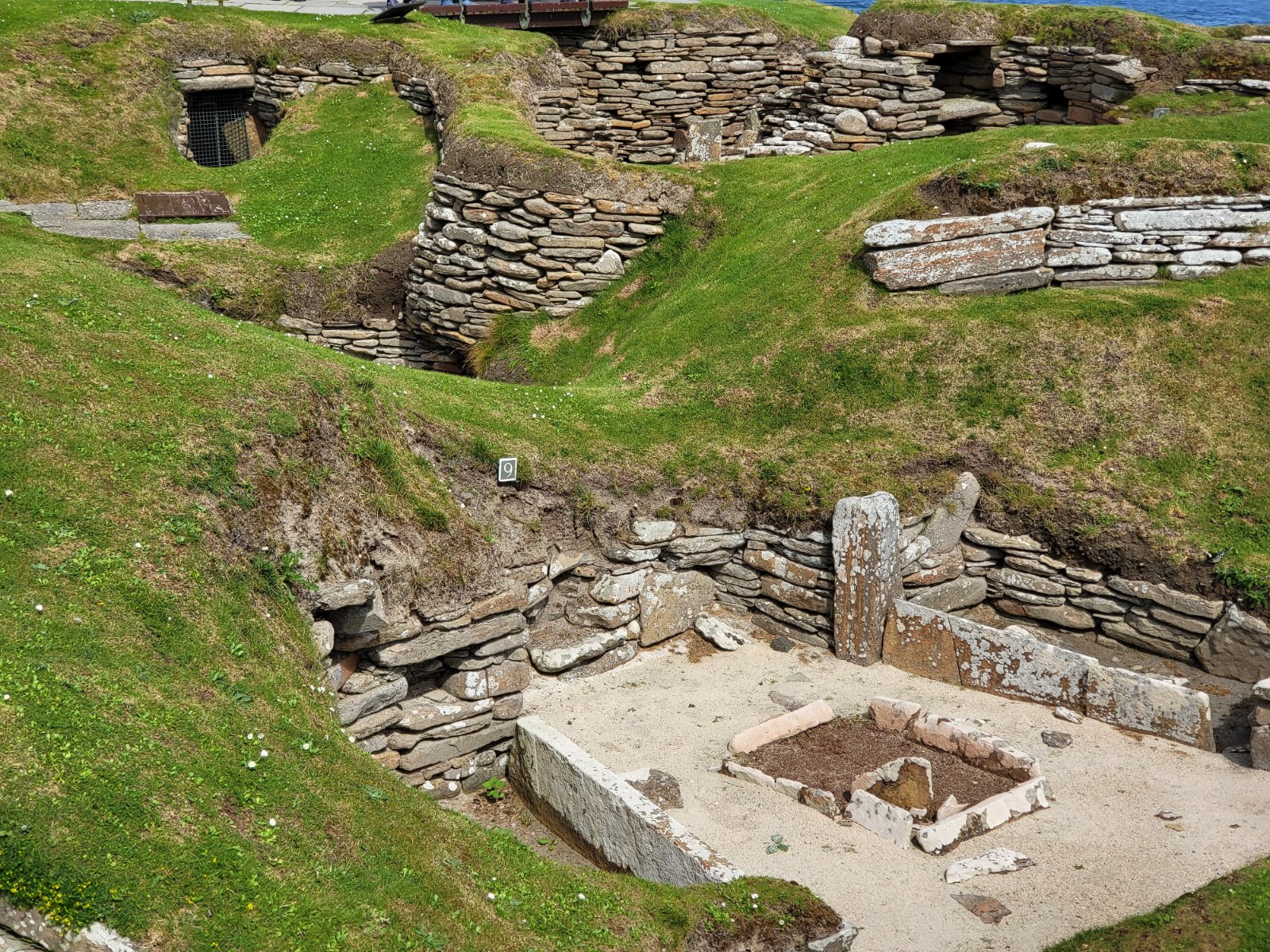
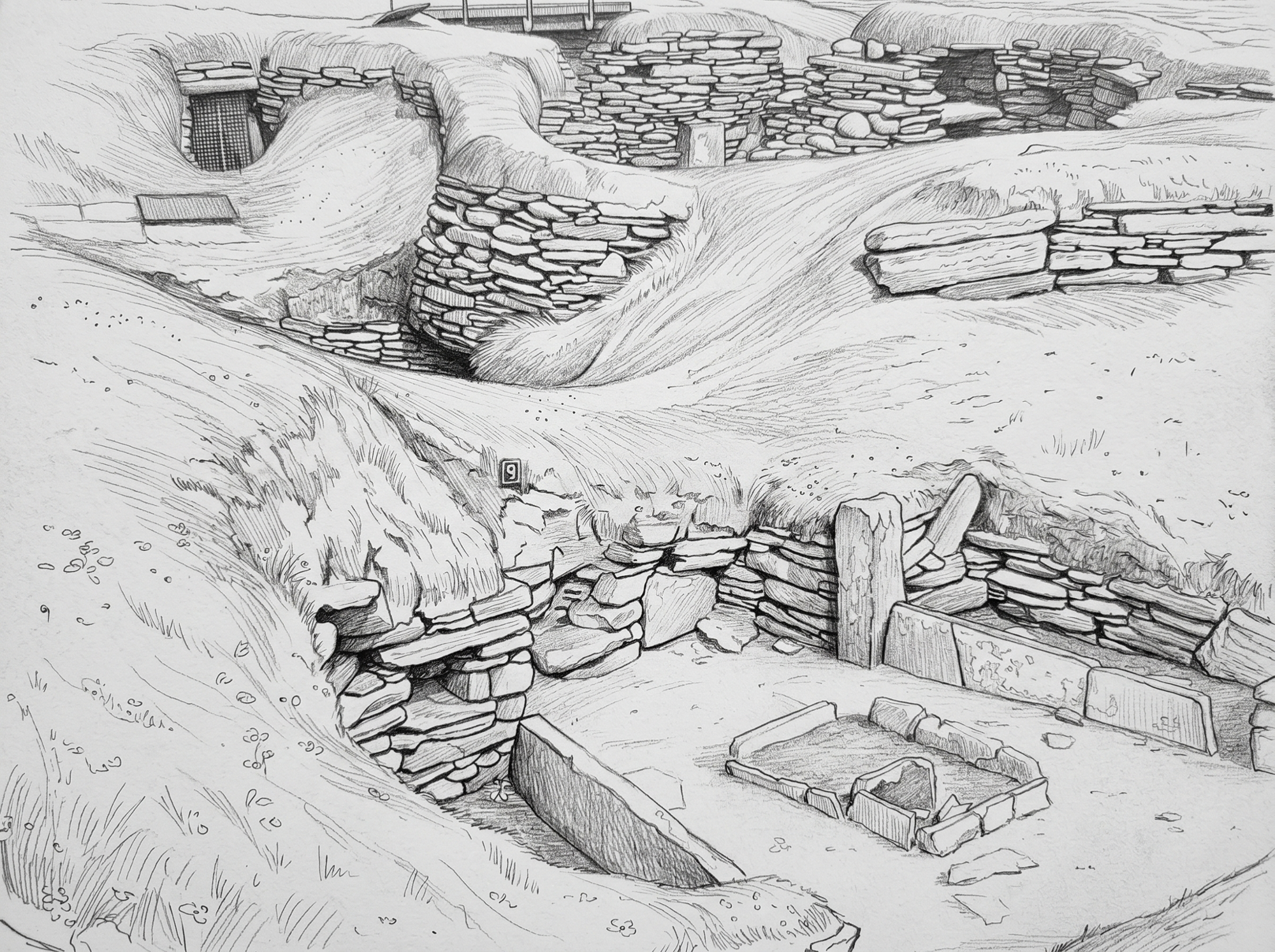
Skara Brae sits low in the Orkney landscape, its ancient stone rooms and foundations tucked into a grassy hillside near the Bay of Skaill. Weathered walls trace the outlines of homes that were lived in thousands of years ago, their gray stones set against vivid grass, dark earth, and the open air of Scotland's northern islands.
This is one of the most remarkable prehistoric places in Western Europe. Long before Stonehenge or the Egyptian pyramids, people were building and living here in a compact Neolithic village, shaping stone into houses, passages, hearths, beds, storage spaces, and domestic furniture. The power of Skara Brae comes from that closeness to everyday life: rooms, thresholds, and fittings still held in the ground.
There is no grand monument rising above the land. Instead, the drama stays close to the soil, in layered stones, worn edges, collapsed foundations, and the sense of lives once sheltered inside these spaces. A small marker in the grass belongs to the present day, while the ruins themselves seem to move on an older rhythm.
Skara Brae is part of the Heart of Neolithic Orkney, a UNESCO World Heritage landscape that also includes Maeshowe, the Stones of Stenness, and the Ring of Brodgar. Together, these sites reveal Orkney as a center of Neolithic culture, ceremony, farming, craft, and settlement. Skara Brae adds the domestic side of that story: stone-built houses, narrow passages, and preserved interiors that make ancient life feel unexpectedly near.
The village was first uncovered after a storm in 1850 stripped away the sand and grass that had hidden it for centuries. That accidental rediscovery still seems to linger here. The ruins appear half-held by the hillside, as if the land is both revealing and protecting them. Grass grows around the stones, weather moves across the site, and the surviving walls carry the marks of human hands and Orkney's coastal climate.
History feels embedded in the soil as much as in the stone. The hillside, foundations, and open sky come together as a reminder of an ancient Orkney settlement shaped by weather, craft, community, and survival. Skara Brae asks for a slower kind of attention, one that notices texture, age, and the quiet dignity of what has lasted.
How This Was Generated
To create a similar Skara Brae scene in FotoMedley, start with a photo that clearly shows the stone ruins, surrounding grass, and archaeological layout.
- Choose the Pencil Sketch style for fine linework, soft monochrome shading, and a classic hand-drawn architectural feel.
- Use a source photo where the stone walls and foundations are distinct enough to read as separate shapes, even against grass or earth.
- Crop to preserve the structure of the site: foreground stones, visible room outlines, surrounding hillside, and any marker or path that gives the ruins scale.
- Keep the original image high resolution so weathered stone edges, grass texture, earth tones, and small archaeological details remain clear after the transformation.
- Preview for clarity and atmosphere; the best result keeps the ruins readable while letting the pencil shading emphasize age, texture, and quiet mood.
For best results, choose photos with natural side light, visible stone contrast, and a simple composition that lets the ancient foundations remain the focus. Historic sites like Skara Brae work especially well when the crop preserves both the archaeological detail and the surrounding landscape context.